5 Reasons to Choose SERP Insight for Your Link Building
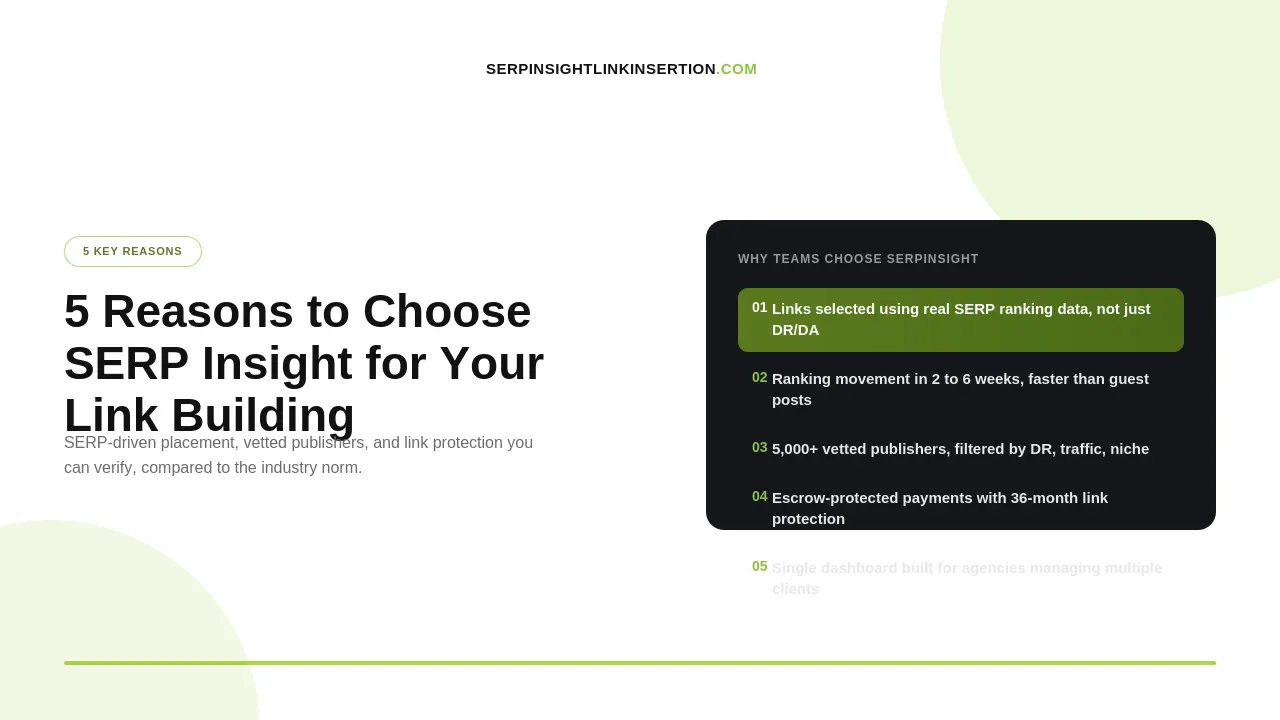
SERP Insight stands out from other link building marketplaces because it selects placements using real search ranking data, not domain metrics alone. This approach delivers faster ranking movement, access to a vetted publisher network, and built-in protection against dropped links. Below are five specific reasons SEO teams and agencies choose SERP Insight over traditional link building methods.
1. It Builds Links Using SERP Data, Not Just Domain Metrics
SERP Insight selects placement pages by analyzing what already ranks for your target keywords. Most link building platforms stop at domain-level numbers like DR or DA. Those numbers tell you how strong a site is overall. They say nothing about whether a specific page has any connection to your topic.
Here’s the problem with metrics alone. A site can carry a DR of 60 and still send you a link that does almost nothing. If the page hosting your link has no organic traffic and no ranking history for anything related to your niche, Google treats that link as weak context. The domain score looks impressive on paper. The actual signal passed to your page stays thin.
SERP Insight flips the order of operations. Instead of starting with domain authority and hoping the page fits, the process starts with the search results themselves. A page gets selected because it already ranks for a keyword close to your target term. That page has proven topical relevance before your link ever goes live.
This matters because Google evaluates links in context. A backlink placed on a page ranking for “project management software” carries more weight for a project management tool than a link from a generic high-DR blog with no topical connection. The surrounding content, the ranking history, and the keyword overlap all feed into how much authority actually transfers.
Agencies that switch to this method often notice one thing quickly. Their link reports start showing fewer placements with bigger individual impact, instead of a long list of links that barely move anything. That shift in outcome is the real argument for SERP-based selection over metrics-only shopping.
2. Results Show Faster Than Traditional Guest Posts
Placement speed is where SERP Insight separates itself most clearly from guest posting. Most campaigns using SERP-based link insertion see measurable ranking movement within two to six weeks. Guest posts typically take one to three months to show any impact.
The gap comes down to indexing. A brand new guest post needs to get discovered, crawled, and trusted by Google before it can pass meaningful authority. That process takes time regardless of how good the content is. A page that already ranks has already cleared that hurdle. Google visits it regularly. Your link gets picked up on the next crawl, not weeks later.
| Factor | Guest Post | SERP Insight Link Insertion |
|---|---|---|
| Time to indexing | Days to weeks | Already indexed |
| Time to ranking impact | 1 to 3 months | 2 to 6 weeks |
| Content required | New article | None, uses existing page |
| Cost | Usually higher | Usually lower |
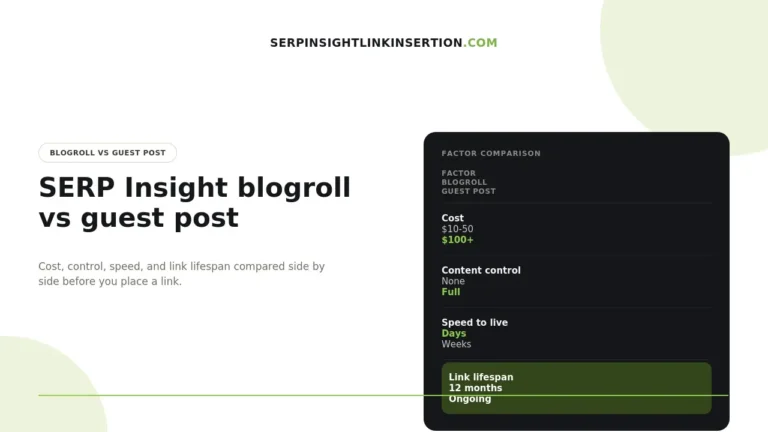
This does not mean guest posts are useless. They still matter when no relevant ranking page exists for your topic, or when you need full control over anchor text and surrounding context. But when speed is the priority and a relevant ranking page already exists, link insertion through SERP Insight gets there faster.
3. Access to a Large, Vetted Publisher Network
SERP Insight connects buyers to a marketplace of thousands of publisher sites, filterable by DR, traffic, niche, country, language, and price. That filtering matters more than it sounds. Manual outreach means emailing sites one at a time and hoping for a reply. A filtered marketplace means finding the right fit in minutes.
Vetting is where a lot of cheaper marketplaces fall short. Sites get listed with inflated traffic numbers, dead backlink profiles, or content nobody actually reads. A common mistake buyers make is trusting a screenshot of a traffic dashboard without checking whether that traffic is current or seasonal.
SERP Insight runs an automated check using Ahrefs and Moz data before a site gets listed, followed by a manual review of traffic, authority, and content quality. That two-step process filters out a large share of the low-quality inventory that floods cheaper platforms. It will not catch everything. No vetting system does. But it removes the burden of manually auditing every single publisher before you buy.
For agencies running campaigns for multiple clients, this filtering saves real time. Instead of building a fresh prospect list for every client niche, the same marketplace can be filtered by industry, country, and budget on demand.
4. Payment and Link Protection Reduce Buyer Risk
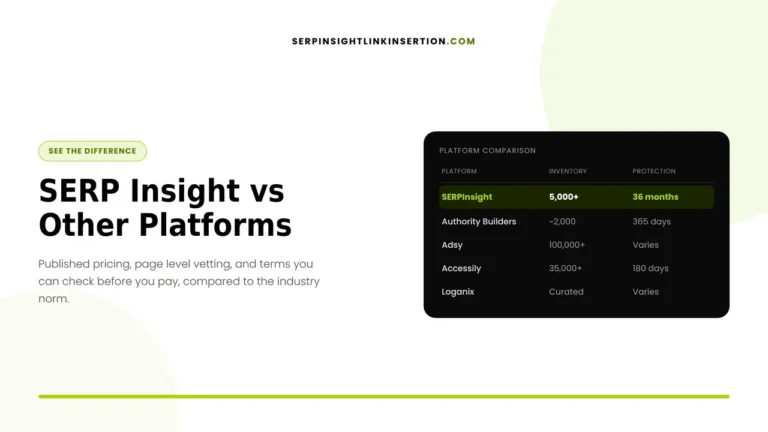
Link building has a trust problem. Buyers pay upfront and hope the link goes live, stays live, and actually matches what was promised. SERP Insight addresses this with escrow-protected payments and 36-month link protection on every placement.
Here’s how it plays out in practice. Payment stays held until the link is confirmed live and verified. The publisher only gets paid after that confirmation. If an order gets rejected or missed, the balance returns to the buyer instead of disappearing into a dispute process.
The 36-month protection covers what happens after the sale. Links drop for all kinds of reasons. A site redesign removes an old article. A publisher takes a page down. An editor decides to clean up outbound links. When that happens within the protection window, SERP Insight works to restore the link or resolve the order under its terms.
This protection matters more than price alone when comparing vendors. A cheap link that disappears in three months costs more in the long run than a slightly pricier link that stays live and gets tracked. Buyers who only compare sticker price often miss this until a link they paid for vanishes with no recourse.
5. Built for Agencies Managing Multiple Clients
Agencies running link building for several accounts need more than a marketplace. They need a system that keeps campaigns separated and reporting clean. SERP Insight handles this through a single dashboard that filters by client, niche, DR, and country in one place.
One agency owner described managing link building for a dozen clients from a single account, filtering by DR and niche to find the right publisher for each one quickly. That kind of operational detail matters more as client count grows. Spreadsheets and scattered email threads stop scaling past a handful of accounts.
Order history staying in one dashboard also simplifies reporting. Instead of piecing together confirmation emails from a dozen different publisher relationships, an agency can pull placement data straight from account history. That saves hours every reporting cycle, which adds up fast across a full client roster.
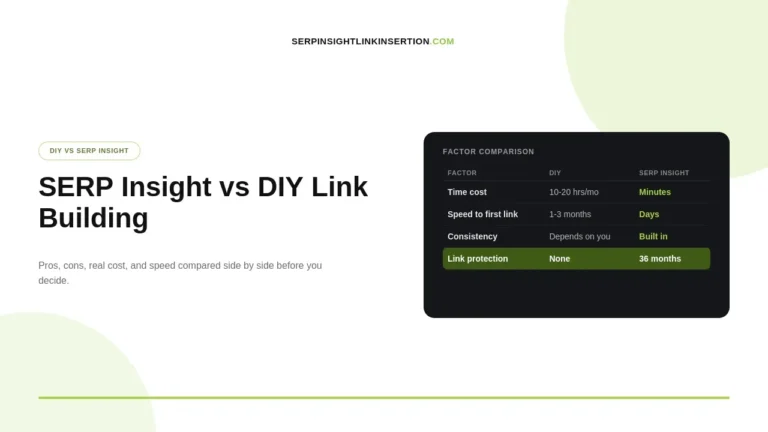
How SERP Insight Compares to Traditional Link Building
| Factor | Traditional Link Building | SERP Insight |
|---|---|---|
| Selection basis | Domain metrics (DR, DA) | SERP ranking data |
| Typical timeline | 1 to 3 months | 2 to 6 weeks |
| Vetting process | Manual, inconsistent | Automated plus manual review |
| Payment risk | Often upfront, unprotected | Escrow-protected |
| Link protection | Rare or nonexistent | 36-month coverage |
| Multi-client management | Manual tracking | Single dashboard |
Which Approach Actually Makes Sense
Link insertion through SERP Insight makes the most sense when you already have a page ranking somewhere between positions six and thirty for a valuable keyword, and that page is well written with a reasonable domain rating behind it. In that situation, a relevant editorial link can push the page toward the top faster than almost any other tactic available right now.
Guest posts still earn their place when no existing ranking page fits your topic, or when you need full control over anchor text and framing from the first sentence. The strongest campaigns in 2026 use both, leaning on SERP-based insertion for speed and guest posts to fill the gaps insertion cannot cover. Skipping the vetting and protection layer to save a few dollars per link is the mistake that costs the most in the long run.
Frequently Asked Questions
Is SERP-Based Link Insertion Safe for SEO?
Yes, when the surrounding content stays relevant to your target page. Google penalizes links that look manipulative, not links placed with genuine topical relevance. Paid insertions should still follow disclosure guidelines where applicable.
How Is This Different From a Niche Edit?
The terms describe the same core tactic: adding a link to an existing, live page. SERP Insight applies a data-driven selection step before the placement, choosing pages based on proven ranking history rather than domain score alone.
How Long Does a Placement Take to Go Live?
Most placements go live within a few hours to a few business days, depending on the publisher’s review process and turnaround time.
What Happens If a Link Gets Removed Later?
Placements include 36-month link protection. If a link drops within that window, the platform works to restore it or resolve the order under its terms.
Does Link Insertion Work for a Brand-New Website?
Not usually. A site needs an existing page with some ranking history and content depth before an inserted link can move the needle. Newer sites often get more value from building content first.