SERP Insight vs DIY Link Building: Pros and Cons
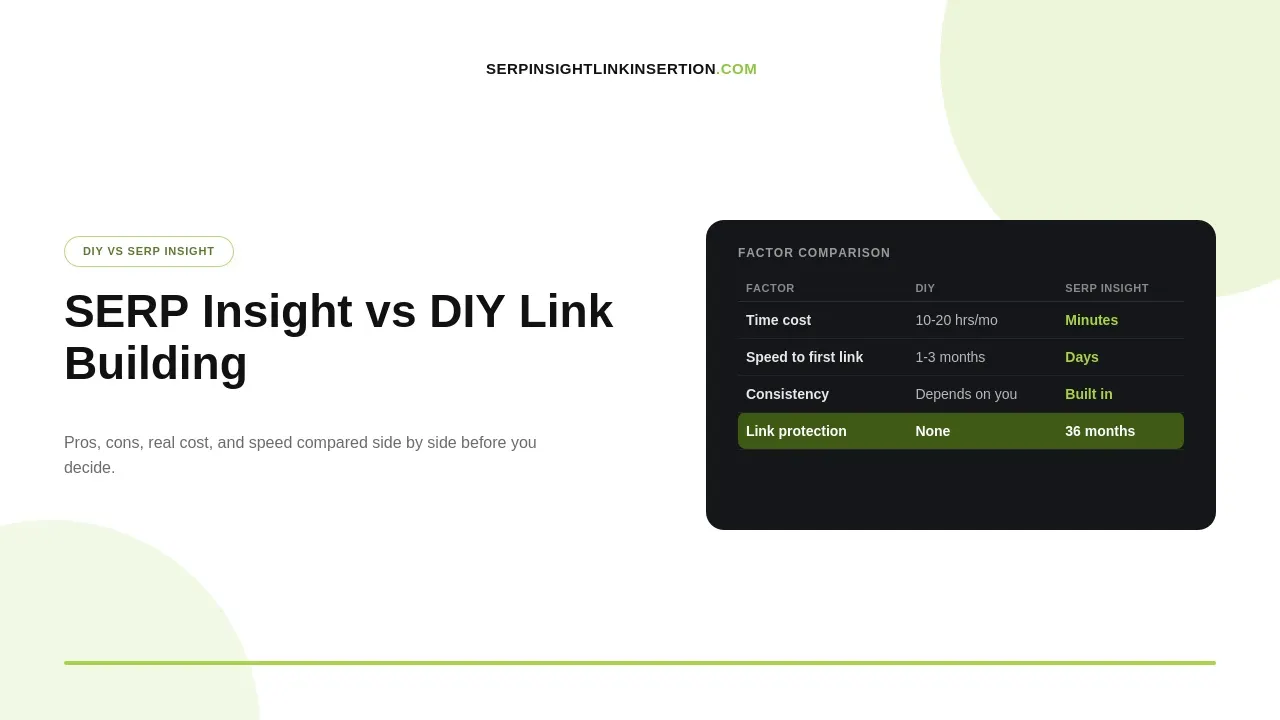
DIY link building costs less in cash but more in time. SERP Insight trades a small per-placement fee for speed, consistency, and a vetted publisher network you don’t have to build yourself. Both paths can work. The right choice depends on what your time is actually worth and how fast you need results.
What Does DIY Link Building Actually Involve?
DIY link building means handling every step of the process in-house, without an agency or marketplace. That includes prospecting relevant sites, sending outreach emails, negotiating placements, writing or briefing content, and tracking whether links stay live.
Most people underestimate how many separate skills this requires. Prospecting means finding sites in your niche with real traffic, not just a high domain rating. Outreach means writing emails that actually get replies, which usually takes dozens of attempts before you find a working template. Tracking means checking months later whether a link is still there, since links get removed all the time without warning.
Tools like Ahrefs, SEMrush, and Moz sit underneath all of this. You need at least one of them to check domain rating, organic traffic, and existing backlink profiles before reaching out to anyone. Without that data, you are guessing which sites are worth your time.
What Does DIY Link Building Actually Cost?
DIY link building is not free. It just moves the cost from a vendor invoice to your own calendar. That distinction matters more than most guides admit.
Here is the math most people skip. If your time is worth $75 an hour, a reasonable rate for a marketing manager or business owner, 15 hours of monthly prospecting and outreach costs you $1,125 in opportunity cost. That number already sits inside typical agency pricing territory. The work did not become free just because no invoice showed up.
Tool subscriptions stack on top of that. A single Ahrefs or SEMrush plan runs somewhere in the range of $100 to $200 a month, and serious link building often needs more than one tool for cross-checking metrics. Add an email finder or outreach tool and the monthly cost climbs further, before a single link goes live.
| Cost Component | DIY | SERP Insight |
|---|---|---|
| Cash cost | Tools plus time | Per-placement fee |
| Time cost | 10-20 hours monthly | Minutes per order |
| Ramp-up before first link | Weeks to months | Days |
What Are the Pros of DIY Link Building?
DIY link building gives you three real advantages that no marketplace can fully replace.
- Full control over messaging. You write every email yourself, so brand voice and positioning never drift from what you intend.
- No dependency on a vendor’s standards. You choose exactly which sites to approach, without trusting someone else’s vetting process.
- Internal knowledge compounds. Every campaign teaches your team something about what works in your specific niche, and that knowledge stays inside the company.
These advantages matter most for teams with long runway and a genuine interest in building an in-house SEO function over the next year or two, not just landing a handful of links this quarter.
What Are the Cons of DIY Link Building?
The biggest problem with DIY link building is not skill. It is consistency. Outreach works like a sales pipeline, and pipelines only produce results when someone runs them every week without fail.
Most in-house teams cannot sustain that discipline once product launches, client fires, or slow months show up. A campaign that started strong in January often goes quiet by March, not because the tactics stopped working, but because nobody had time to keep sending emails. This is an operational problem, not a competence problem, and it is the single biggest reason DIY campaigns underperform their potential.
Ramp-up time compounds this. Building real relationships with publishers takes months of consistent outreach before response rates improve. Delaying that ramp-up by even a single quarter means losing months of link accumulation that would have compounded by the time you actually need results.
A common mistake teams make here is treating link building as a side project squeezed between other priorities, instead of a standing weekly function with a fixed time block. Without that fixed block, the campaign drifts and eventually stalls.
What Does SERP Insight Do Differently?
SERP Insight skips the ramp-up period by giving you access to an already vetted publisher network, selected using real search ranking data instead of domain metrics alone. You are not building relationships from zero. You are ordering from a system that already exists.
This matters most when speed is the actual priority. A DIY campaign starting from scratch typically needs one to three months before outreach relationships mature enough to produce reliable placements. SERP Insight compresses that timeline to days, because the vetting and relationship work already happened before you placed an order.
The tradeoff is direct. You pay a per-placement fee instead of investing unpaid hours, and you accept a system’s vetting standards instead of hand-picking every prospect yourself. For teams where 10 to 20 hours a month is genuinely unavailable, that tradeoff is usually worth it.
What Are the Pros of Using SERP Insight?
- Speed. Placements typically go live within days, not the months a fresh outreach campaign needs to warm up.
- Built-in risk protection. Escrow-protected payments and 36-month link protection cover scenarios DIY campaigns have no defense against, like a publisher quietly removing your link six months later.
- No hiring or tooling overhead. You skip the cost of a specialist salary, tool subscriptions, and the training period a new hire needs before producing results.
What Are the Cons of Using SERP Insight?
Being direct here matters more than sounding like a pitch. SERP Insight is not the right fit for every situation, and pretending otherwise would be dishonest.
The cost structure is ongoing per placement, rather than a one-time internal time investment that theoretically gets cheaper as your team gets better at it. You also get less hands-on control over every single outreach message, since the vetting and negotiation already happened before the order reached you. Teams whose actual goal is building a long-term, in-house SEO function will not get that outcome from a marketplace, no matter how good the placements are.
SERP Insight vs DIY Link Building: Side by Side
| Factor | DIY | SERP Insight |
|---|---|---|
| Cash cost | Low, mostly tool subscriptions | Per-placement fee |
| Time cost | High, ongoing weekly work | Minimal, order-based |
| Speed to first link | Slow, 1 to 3 month ramp | Days |
| Consistency | Depends entirely on internal discipline | Built into the system |
| Control | Full control over every message | Moderate, system-vetted |
| Risk protection | None built in | 36-month link protection |
| Best fit | Long-term in-house capability building | Speed and consistency priority |
Which Approach Actually Makes Sense
If your business genuinely wants an in-house SEO function two years from now, and you can commit fixed weekly hours to outreach without letting it slip during busy months, DIY link building builds something durable over time. If you need consistent, faster placements and the real cost of your own hours already exceeds a per-placement fee, SERP Insight removes the ramp-up problem entirely.
Most growing teams end up using both, DIY for slow-building relationships in their core niche and SERP Insight for filling gaps faster than an internal pipeline currently allows. Choosing one exclusively usually costs more than mixing the two, whichever direction you lean.
FAQs
Is DIY Link Building Still Effective in 2026?
Yes, when treated as a standing weekly function with dedicated time, not a side project. The tactics still work. Consistency is what determines whether they produce results.
How Many Hours Does DIY Link Building Actually Take Per Month?
Most estimates land between 10 and 20 hours a month for prospecting, outreach, and tracking combined, depending on how aggressive the campaign is.
When Does It Make Sense to Switch From DIY to a Service Like SERP Insight?
Switch when your internal time cost, calculated honestly at your actual hourly value, starts exceeding what a per-placement fee would cost, or when you need results faster than a fresh outreach campaign can realistically deliver.
Can I Do Both DIY Link Building and SERP Insight at the Same Time?
Yes. Many teams run DIY outreach for long-term relationship building while using SERP Insight for placements that need to move faster than an in-house pipeline currently allows.