SERP Insight Blogroll: What It Is and Whether It Belongs in Your Link Building Plan
A SERP Insight blogroll is a sidebar or homepage link placement chosen using live search ranking data instead of a flat domain score. The site gets picked because its specific pages perform in Google, not because the domain carries a high number on paper. This guide breaks down how it works, where it fits next to guest posts and link insertions, and where it can go wrong.
What Is a SERP Insight Blogroll?
A blogroll is a curated list of outbound links, usually placed in a website’s sidebar or homepage footer. Bloggers once used blogrolls to recommend other sites they read. Today, most blogrolls exist for one reason: passing link equity to a paying site.
A SERP Insight blogroll adds a filtering step to that old tactic. Instead of buying a spot on any high Domain Rating site, the buyer or vendor checks what that site’s pages actually rank for first. The selection looks at current traffic, keyword footprint, and whether the domain still shows up in real search results. A site can carry a Domain Rating of 60 and still send zero value if its pages lost rankings months ago.
This matters because a blogroll link sits outside the article body. It has no surrounding context, no topical relevance built into a paragraph, and no editorial reason for existing beyond the placement itself. Google’s systems can spot that pattern. Adding SERP-based vetting does not remove the risk, but it narrows the pool to domains that still show active ranking signals.
How SERP Insight Blogrolls Differ From Ordinary Blogroll Backlinks
Most blogroll backlinks sold on marketplaces like Fiverr, Kwork, or Upwork get bundled by Domain Rating alone. A seller lists “DA 50 sidebar blogroll backlinks” and buyers purchase in bulk, often 50 or 100 at a time. The pitch is volume and a number, not performance.
A SERP Insight version flips that order. The process usually looks like this:
- Identify the buyer’s target keyword or topic.
- Pull the current top 10 to 20 ranking pages for that query.
- Cross-check which of those domains, or domains closely tied to that niche, accept blogroll placements.
- Confirm the specific page or homepage still receives organic traffic.
- Place the link and monitor whether rankings or referral traffic shift afterward.
That extra vetting step is the entire difference. Bulk blogroll sellers skip steps two through four. A buyer paying $20 for 50 links is not getting SERP-level scrutiny on any of them, regardless of what the DA number says on the listing.
SERP Insight Blogroll vs Guest Post vs Link Insertion
SERP Insight, as a marketplace concept, offers three main placement types. Each one trades speed for control differently.
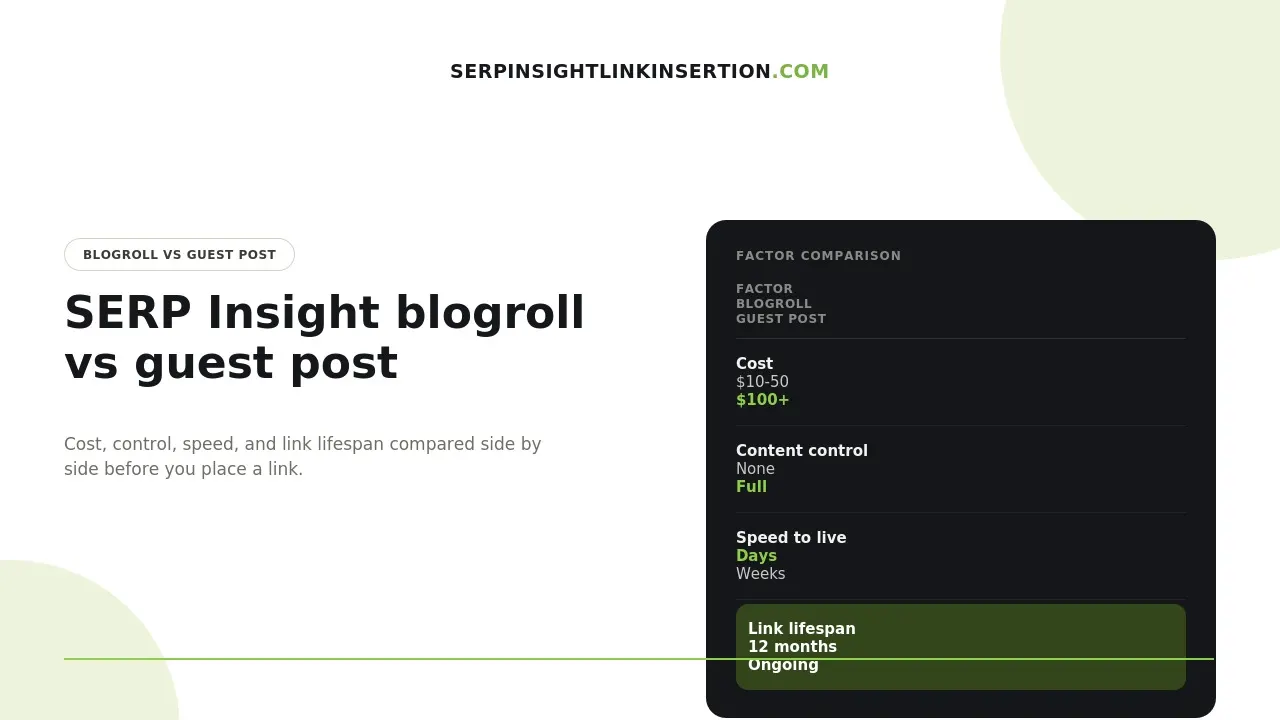
| Placement Type | What Happens | Speed | Content Control | Typical Use Case |
|---|---|---|---|---|
| SERP Insight Guest Post | A new article gets written and published on the publisher’s site | Slowest, waits on indexing | Highest, full topic and structure control | Building topical authority on a new subject |
| SERP Insight Link Insertion | A backlink gets added into an existing, already-ranking article | Fastest, no indexing delay | Lowest, limited to what the page already covers | Quick authority transfer on a proven page |
| SERP Insight Blogroll | A link gets added to a sidebar or homepage list, not inside an article | Fast, similar to insertion | Minimal, usually just anchor text and URL | Broad exposure and steady link count |
A guest post gives a buyer a full asset: a new page, new content, and a natural place for the link. A link insertion skips the writing but borrows an existing page’s authority. A blogroll skips both. It offers neither new content nor contextual relevance. What it offers is a permanent-looking spot on a page Google already crawls, at a lower price than either alternative.
I would treat a blogroll placement as a supporting tactic, not a primary one. It works best mixed in with two or three insertions and one guest post per month, not as the only link type in a campaign. A backlink profile built entirely from sidebar links looks unnatural to anyone who audits it manually, and increasingly to automated systems too.
Why the SERP Data Layer Actually Matters Here
Buying a link based on Domain Rating alone ignores a basic fact: DR measures the domain’s overall backlink profile, not whether any specific page still ranks. A domain can hold DR 55 from links earned five years ago while every current page sits on page four of Google. A blogroll link on that domain’s homepage passes almost nothing useful.
Checking SERP data before buying answers three practical questions:
- Does the domain still rank for any keyword in the buyer’s niche right now
- Is the homepage or sidebar host page still receiving organic clicks
- Has the site been flagged, deindexed, or hit by a manual action recently
Skipping these checks is the single most common mistake I see in bulk link orders. A buyer sees a big number, assumes it reflects current performance, and finds out three months later that the link did nothing. SERP-level vetting exists specifically to catch that gap before money changes hands.
The Real Risk: Google’s Stance on Paid Links
Google’s guidelines prohibit buying or selling links that pass ranking value. A SERP Insight blogroll, when paid for and placed purely for SEO benefit, falls under that policy. This applies whether the seller calls it a blogroll, a sidebar link, or a homepage feature.
The counterargument some vendors make is that SERP-based vetting reduces risk because the links sit on real, active sites rather than dead PBN pages. That is true to a point. A vetted placement is less likely to sit on a spam network. It does not make the transaction editorially earned. If money moved hands specifically for the link, the core policy risk stays the same regardless of how carefully the target page was chosen.
Editorially earned blogroll mentions, where a publisher adds a link because they genuinely find a resource valuable and no payment occurs, carry none of this risk. That distinction, paid versus earned, matters more than DR, traffic, or any other metric on the page.
Pricing and What Actually Changes the Cost
Blogroll placements typically cost less than guest posts because there is no writing involved. Prices across the marketplaces I have reviewed for this space range from under $10 for bulk, low-authority placements to a few hundred dollars for a single spot on a site with real, current traffic in a relevant niche.
Three factors move the price more than anything else:
- Current organic traffic to the specific page hosting the link, not just domain-wide traffic
- Niche relevance between the buyer’s site and the publisher’s content
- Whether the placement is marketed as permanent or capped at a fixed term, commonly 365 days
That last point catches buyers off guard often. A cheap placement that looks permanent may only be guaranteed to stay live for a year under the vendor’s terms of service. Anyone buying at scale should ask this question directly before paying, since it changes the actual cost per year of the link.
How to Evaluate a Blogroll Placement Before Paying
Before agreeing to any blogroll spot, check these five things:
- Pull the site’s top pages in a rank tracker and confirm at least some pages rank in the top 30 for real keywords.
- Check organic traffic trend for the last six months, not just a lifetime total.
- Search the domain name plus “penalty” or “manual action” to rule out recent issues.
- Confirm the niche overlap between the publisher’s audience and the buyer’s site.
- Ask directly whether the placement is permanent or time-limited, and get it in writing.
Skipping any one of these five checks is how buyers end up with a link that sits on a page nobody visits and Google no longer trusts.
Common Mistakes Buyers Make
The mistakes I see most often with blogroll purchases follow a pattern:
Buying on Domain Rating alone. A high DR number says nothing about current page-level performance. Always check the specific page, not the domain average.
Buying in large bulk batches. Fifty or a hundred blogroll links placed in one week creates an unnatural link velocity spike that stands out in any audit.
Ignoring niche match. A finance site linking from a random lifestyle blogroll adds little topical value, even if the domain metrics look fine.
Assuming permanence. Many vendors cap link lifespan at 365 days. Treat every placement as temporary unless the contract states otherwise.
Skipping traffic checks. A domain with zero current organic traffic sends no real authority, regardless of its backlink history.
Does a SERP Insight Blogroll Help With AI Overviews and AI Search
Blogroll links carry no content context, so they do nothing directly for AI Overview citations or generative search visibility. AI systems pull answers from pages with clear, well-structured information, not from sidebar link lists. A blogroll link can still support the domain’s overall authority indirectly, which may help a page rank higher and get considered for citation. The link itself is not the mechanism doing that work.
My Take
A SERP Insight blogroll is worth considering as a small, supporting piece of a link profile, not a centerpiece strategy. The SERP-based vetting step is a genuine improvement over buying blind on Domain Rating, and it filters out a meaningful share of dead or irrelevant domains before money moves. That said, the format itself is thin. No content, no context, capped permanence in many cases, and the same underlying Google policy risk as any paid link.
If a buyer has budget for one link type this month, a guest post or a link insertion on a genuinely relevant, current-ranking page will do more for topical authority than a blogroll spot. Blogroll placements make sense as a low-cost addition once the primary link types are already in place, spread out over time rather than bought in bulk.
FAQs
What is a SERP Insight blogroll?
It is a sidebar or homepage backlink placement selected using current search ranking data, rather than a flat Domain Rating or Domain Authority score alone.
Is a SERP Insight blogroll different from a regular blogroll backlink?
Yes. A regular blogroll backlink usually gets sold based on Domain Rating alone. A SERP Insight version adds a check on whether the specific page still ranks and receives traffic before the sale.
Is buying blogroll backlinks safe under Google’s guidelines?
Paid links that pass ranking value violate Google’s link scheme policy, regardless of how the vendor vets the target page. Vetting reduces the chance of landing on a spam network, but it does not remove the policy risk.
How much does a SERP Insight blogroll placement cost?
Prices range from under $10 for bulk, lower-authority spots to a few hundred dollars for a single placement on a page with strong current traffic and niche relevance.
Are blogroll backlinks permanent?
Not always. Many vendors guarantee placement for a fixed term, commonly 365 days, rather than for life. Confirm this before paying.
Is a blogroll placement better than a guest post or link insertion?
Not usually. A guest post builds a full new asset with content control. A link insertion borrows an already-ranking page’s authority. A blogroll offers neither, though it costs less and takes less time to place.
Does a blogroll backlink help with AI Overviews?
Not directly. AI Overviews pull from well-structured content, not sidebar link lists. A blogroll link may support domain authority indirectly, which can help separately with visibility.
How many blogroll links should I buy per month?
Two to five placements spread across relevant, currently-ranking sites is a sustainable pace. Buying fifty or more at once creates an unnatural link pattern that stands out in an audit.